Gerard Byrne, For example ; a sketch of Five Elevations, 1971-72, video, 9′ 37”, loop, mute, 2011
For his exhibition at the Centre d’édition contemporaine in 2011 (05.04 – 07.16.2011), Gerard Byrne has presented a film referring to a 1971-72 piece by Richard Serra he had had access to in the parc of a private collection near London: Five Elevations. This film follows a series of researches on abstraction and minimalism, and among others a previous film installation, A thing is a hole in a thing it is not (videos, 2010). It has been produced and presented first at the Van Abbemuseum, Eindhoven, then at The Renaissance Society, Chicago, at Lismore Castle Arts, County Waterford, Ireland, and at the 2010 Glasgow International Festival of Visual Art. This movieis made up of several short films showing works from the collection of the Van Abbemuseum, which somehow represent the quintessence of American minimalism: with paintings and sculptures by Carl Andre, Donald Judd, Dan Flavin, Robert Morris or Frank Stella. Reinstalled in the Eindhoven halls by Gerard Byrne, the works replay their presence in the museum. The camera records the works as well as the context: museum workers, photographs, cleaners, attendants and visitors. The shots result from large scanning or a back-and-forth between the surrounding space, the apparently insignificant details and the art works themselves, objectified as well. The shift in point of view operated by Gerard Byrne is recontextualized in the field of minimalism by Penelope Curtis in her essay A local address, in Tuxedo Junction (1960), about A thing is a hole in a thing it is not:
“This means that we are left with the possibility of thinking of Minimalism’s project as both romantic and classical; as a work of the imagination as well as of manufacturing; an idea as well as an object ; a dream as well as a result. It is also made clear, however, that Minimalism is not just about us, and our experience, but also about how other experiences are mediated for us, whether in text, voice or imagery.“1 Besides, the epigraph introducing the catalogue reads: “Assembled and edited by Gerard Byrne upon the achievements of the Minimalists and their critics.”2
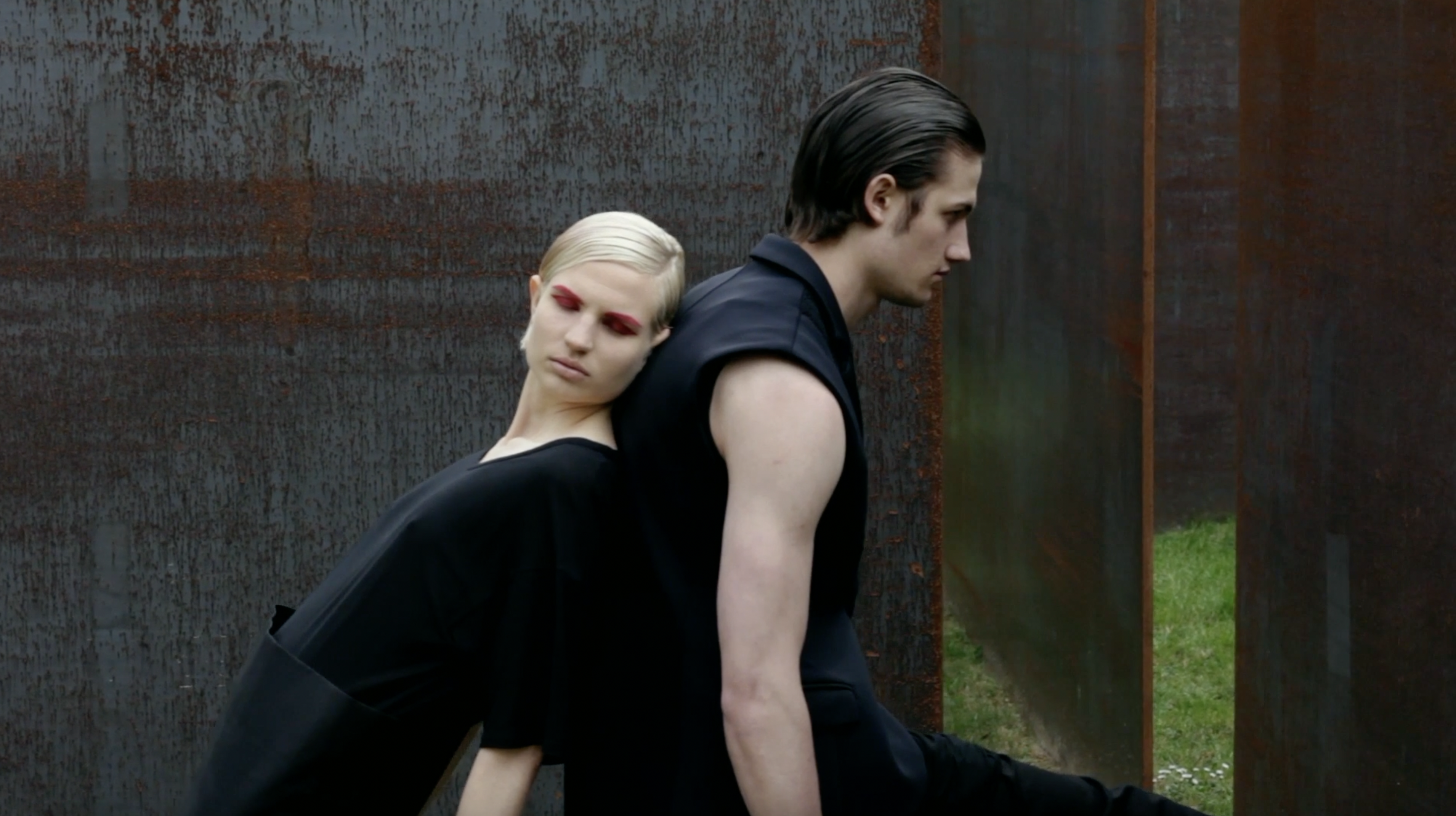
In For example; a sketch of Five Elevations, 1971-72, the camera moves around Five Elevations. Through shots using a variety of standards of cinematic grammar, creating a subjective image of this complex sculpture. In the background, and without being the subject of the movie, the camera records simultaneously and partly a fashion shoot taken place here by coincidence. Despite this double setting, the work of Richard Serra remains the principal character of this fiction, although the confrontation with the fashion shoot transforms Five Elevations in a kind of “Stonehenge“, provoking a back-clash between these two temporal dimensions: eternity vs the ephemeral.
As in his previous works, Gerard Byrne puts the question of the historical or the artistic transmission of a well-known reality, media-covered, phenomenological, or more: iconic. He puts this reality to the proof of its recording or re-recording (film, photography), of its diffusion and its reception:
“The idea was to construct for each work a kind of self-awareness of being viewed. I am interested in how the camera tries to construct and elaborate those viewpoints in a filmic sense. I recall Beckett’s Film quoting our fellow Irishman Bishop Berkeley – “To be is to be perceived.”
Gerard Byrne, For example ; a sketch of Five Elevations, 1971-72, HD video, loop, color, mute, multimedia player (full HD), 20 copies, 2 A.P. and 2 H.C., numbered, dated et signed. Edition of the Centre d’édition contemporaine, Geneva, 2011
Gerard Byrne’s works have been exhibited at Centraal Museum Utrech (2020), Sessession, Vienna (2019), Moderna Museet, Stockholm (2017), Kunstmuseum St. Gallen (2015), FRAC Pays de Loire, Nantes (2014), Baltimore Museum of Art (2013), Bonniers Konsthall, Stockholm (2013), Whitechapel Gallery, London (2013), Bonniers Konsthall, Stockholm (2013). Gall (2015), FRAC des Pays de la Loire, Nantes (2014), Baltimore Museum of Art (2013), Bonniers Konsthall, Stockholm (2013), Whitechapel Art Gallery, London (2013), Renaissance Society, Chicago (2011), Lisson Gallery, London and New York (2017, 2013, 2009 and 2007). He has also exhibited his works at the Kunstverein, Düsseldorf (2007) and for the Irish Pavilion at the 52nd Venice Biennale (2007). He has taken part in several group shows at Tate Britain, London (2006, 2010 and 2014), MUDAM, Luxembourg (2010), Kunstmuseum Basel, Basel (2010), Malmö Konsthall (2010) and Henry Moore Institute, Leeds (2010), as well as the Turin, Gwangju and Sydney Biennales (2008) and the Lyon Biennale (2007). He took part in the ILLUMInazioni exhibition for the 54th Venice Biennale (2011), Documenta 13, Kassel (2012), The Art of Memory, Bonniers Konsthall, Stockholm (2012), Salon der Angst, Kunsthalle, Vienna (2012) and Trapping Lions in the Scottish Highlands, Aspen Art Museum (2912), at Curiosity, De Appel, Amsterdam (2012), The Persistence of Objects, Lismore Castle, for Out of Body, Out of Time, Out of Place, Skulptur Projekte 2017, Münster (2017) and at the Busan Biennale (2020).
1 Penelope Curtis, “A local address”, in Gerard Byrne, Tuxedo Junction, 1960, Lismore Castle Arts, Lismore, Co Waterford, Ireland, 2010 2 Gerard Byrne, Tuxedo Junction, 1960, Lismore Castle Arts, Lismore, Co Waterford, Irelande, 2010, flyleaf
This project is sponsored by the Federal Office of Culture and the Republic and the Canton of Geneva.
Gianni Motti’s work reveals the hidden facets of the political system, and of the state of the world more generally. The artist likes to consider “that which escapes the gaze,” beyond appearances and consciousness, such as paranormal and anticipation phenomena, sectarian movements, primitive instincts and conspiracy theories.
Gianni Motti’s works are neither sculptures nor installations, nor even ready-mades, or perhaps assisted ready-mades, sometimes multiples, rarely unique pieces, but foremost witness accounts – texts, photographs, films – of actions. Gestures to be considered “as is,” “as in life,” but which on closer inspection subvert and challenge their primary function and meaning, be it social, political or symbolic. Gianni Motti likes to demystify beliefs, morals and consensuses by reinvesting them with a new meaning, an offbeat and unexpected stance or a denunciation which is often ironic and critical.
Gianni Motti’s method of subversion seems akin to attempts at circumvention, or even sleights of hand: he died on July 29th, 1989, organised his own burial in Vigo (Entierro n°1) and gave himself the freedom to rise again, to become someone else and to choose his identity. The management of his retrospective in 2004 at the Migros Museum in Zurich (Plausible Deniability) was even more significant. The space was entirely divided up by plywood partitions, reconstructing an empty labyrinthine path that relentlessly directed the viewer towards the museum’s back courtyard. The absent works were replaced by a commentary, undertaken by several guides responsible for presenting the important stages of Gianni Motti’s work. The artist thereby substituted reality with narration; a means of organising and controlling his own posterity, proposing a narrative, constructing a legend and definitively conferring a fictional status on his artistic practice.
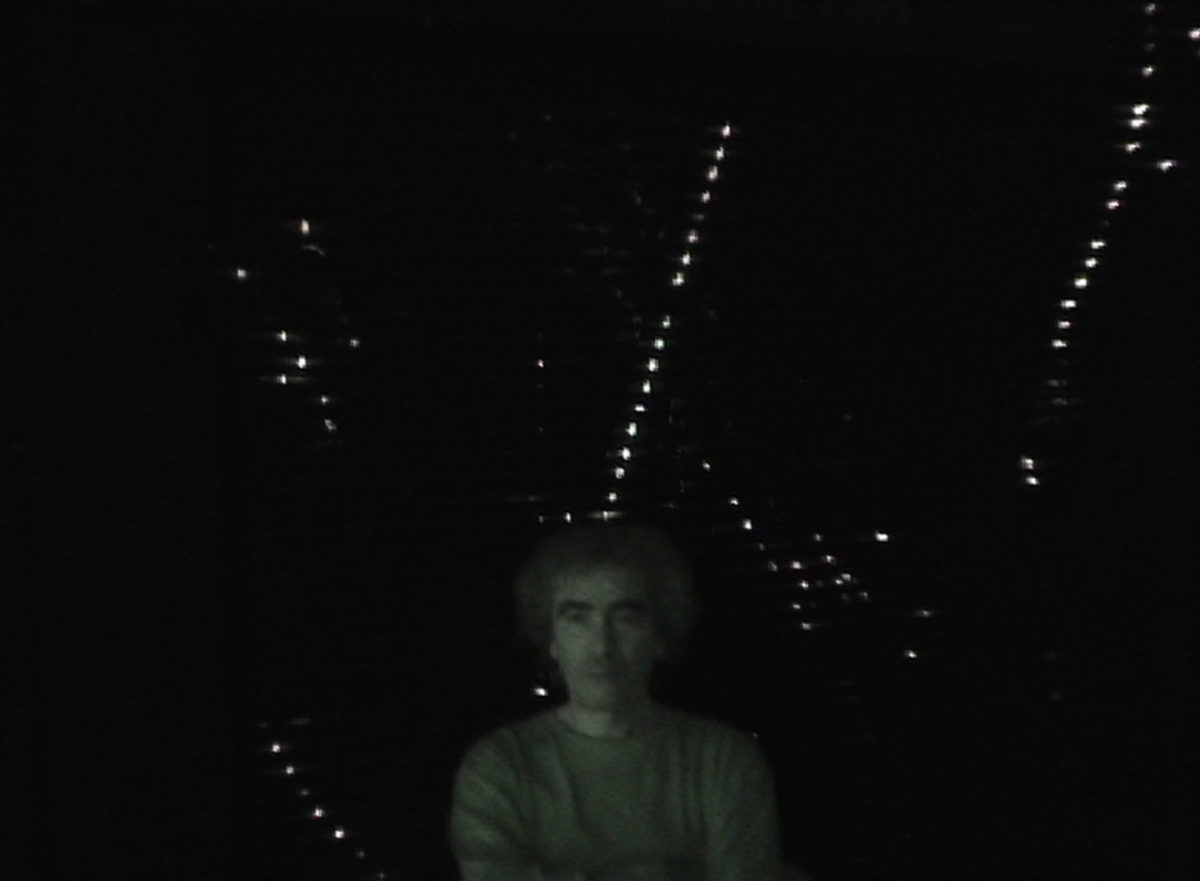
For the Videos: new and revisited project, and this first series of screenings, we present Gianni Motti’s video entitled Cosmic Storm, Cern, which was made at CERN using the infra-red technique. It recounts Gianni Motti’s experience, made possible thanks to a group of scientists who discovered the existence of neutrinos, invisible and evanescent particles derived from the nuclear reaction of the heart of the sun. Enclosed in a kind of box, Motti is repeatedly struck by these neutrinos whose trajectories can be visualised thanks to a system of detectors. These inframince particles continuously strike all bodies, human or otherwise, and are constantly present in our environment, without us ever seeing or perceiving them. They can travel miles to hit mountains or land at the bottom of oceans.
This video is an edition produced by the CEC for Gianni Motti’s solo exhibition, Perpetual Channel, which took place in November 2006, presenting his immersion for several days in the very closed world of CERN and its researchers.
Gianni Motti (1958, Sondrio) lives and works in Geneva. His work has been presented in various solo exhibitions, such as EX-POSITION21, Galerie Mezzanin, Geneva (2021); Ex-position at the Helmhaus, Zurich (2018). He has also taken part in numerous group exhibitions: Vertrauen at the Helmhaus Zurich, Zurich (2022); Acquisitions 2021 at the Fonds d’art contemporain de la Ville de Genève (2022).
This project is sponsored by the Federal Office of Culture and the Republic and the Canton of Geneva.
Alexandre Bianchini, Detroit on Circle, digital transfer of Super 8 films, 12’24’’, music, 1996
Immersed in an environment that favours abstract painting, influenced by the Swiss tradition, concrete art and the 1960s myth of American abstraction, Alexandre Bianchini sought out other influences within the conceptual movement of the 1960s and 70s, with Andy Warhol and pop art. With the same desire to identify more immediate and more critical gestures, he has revisited lighter, more mobile and even obsolete mediums, such as Super 8 film, artists’ books and print-outs.
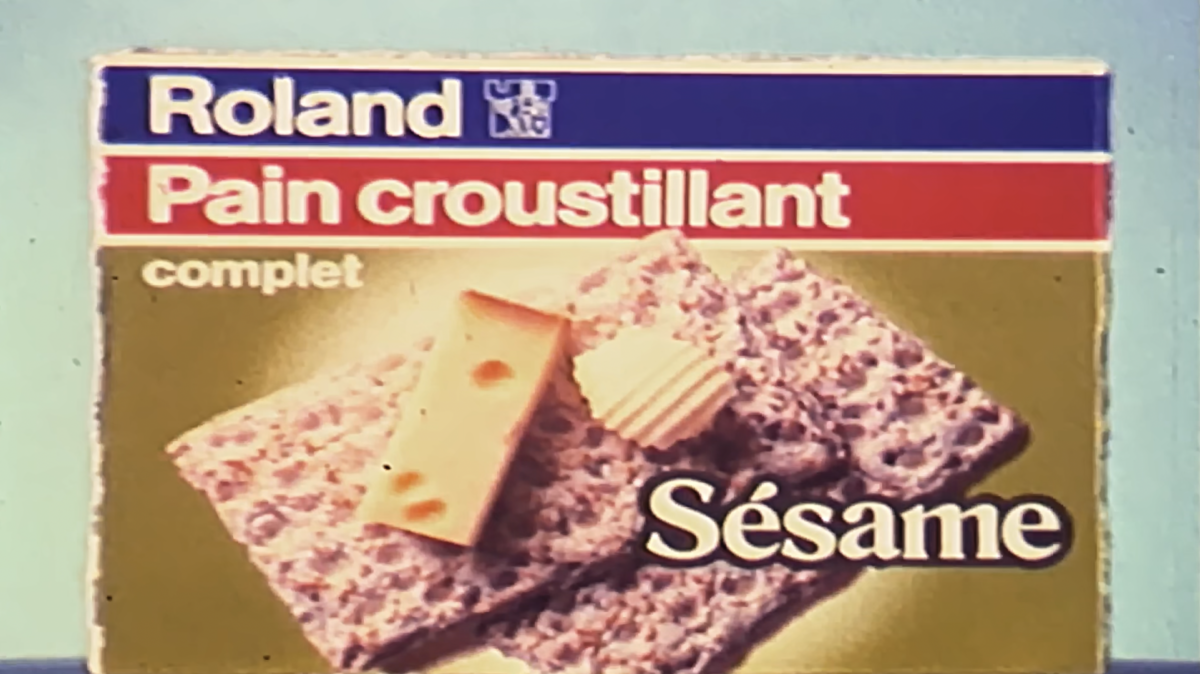
For the screening program, Videos: new and revisited, the new CEC website and its “Recent videos” and “Archives” components, we have chosen the edition of a series of Super 8 films by Alexandre Bianchini, Detroit on Circle, dating from 1996, from the CEC collection. Each of these short, 3-minute films features a soundtrack of techno music excerpts, direct references to artists from the Detroit music scene, with Robert Hood and Jeff Mills, or to the artist’s immediate environment and the techno scene, with DJ Sid and Hubert Mean.
Panning in and out to the rhythm of the sound excerpts, Bianchini films a piece of cardboard taken from a box of “crispy sesame bread” by the Swiss brand Roland, which is fixed vertically in the centre of a vinyl record playing at 33 rpm. This little carousel alternately presents this advert for sesame bread and the image glued to the back of the cardboard, sometimes of a Spartan room, sometimes of a jungle path, a souvenir of the artist’s visit to Colombia. The video of this endless carousel, caught in a back-and-forth movement, with its very rhythmic, repetitive and catchy techno sounds, provokes a hypnotic and old-fashioned effect, making spectators oscillate between these Swiss crackers and the sensations of a trip to Colombia.
Alexandre Bianchini (1966, Geneva) lives and works in Geneva. His work has been presented in various solo exhibitions, such as Child of Rage at Locus solus, Prilly (2022); Sans tain sans titre au Halle nord, Geneva (2018). He has also taken part in numerous group exhibitions: Acquisitions 2021 at the Fonds d’art contemporain de la Ville de Genève, Geneva (2022); Etat des lieux at the Maison Gaudard, Lausanne (2022).
This project is sponsored by the Federal Office of Culture and the Republic and the Canton of Geneva.
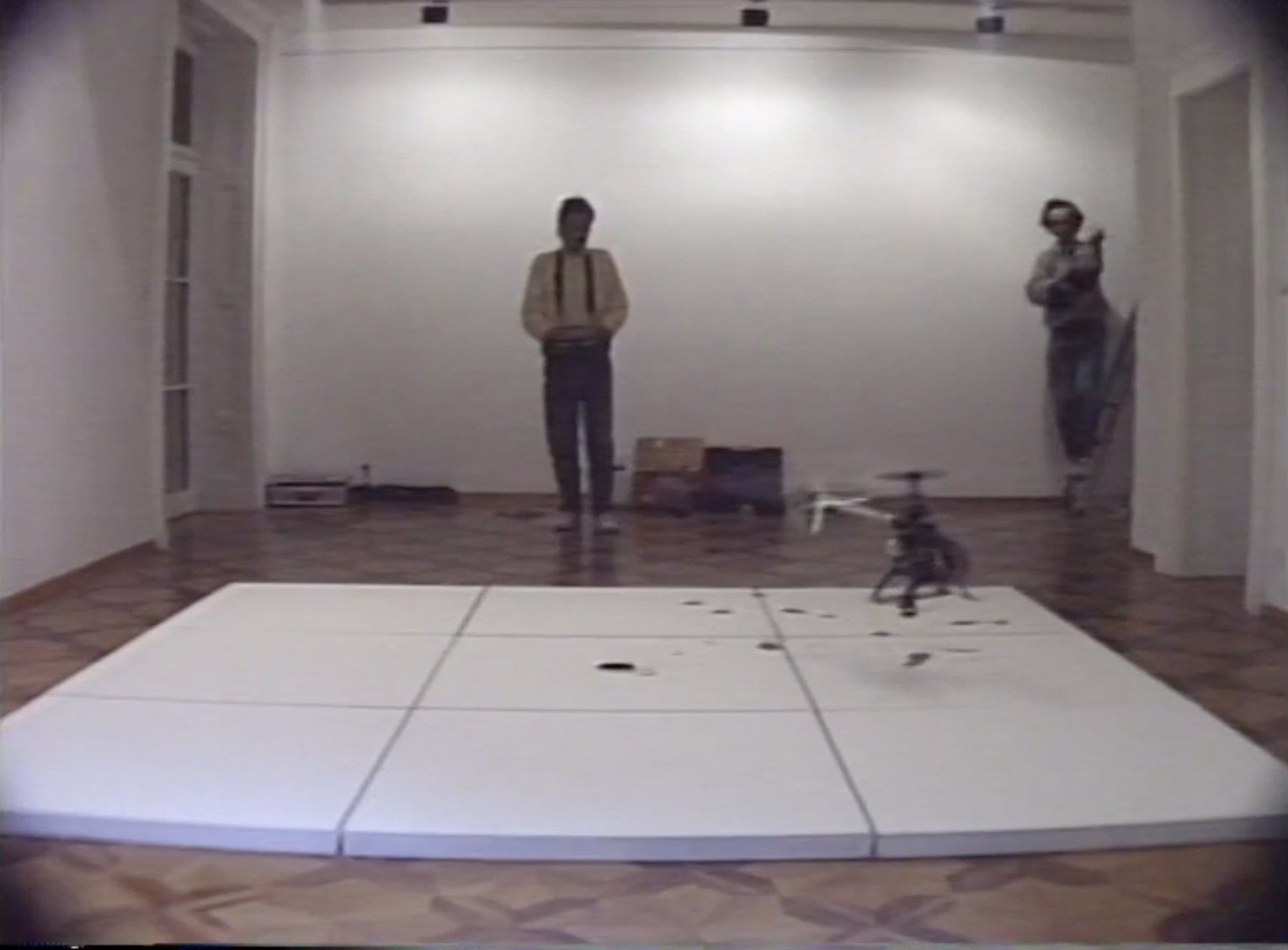
This video is a recording of a performance by Roman Signer, filmed behind closed doors directly in the Centre’s exhibition room (in 1990, Centre genevois de gravure contemporaine) prior to his solo exhibition, which ran from October 26th to December 8th, 1990. He presented the various elements used for this performance: a helicopter with a brush, a tin can filled with black ink and nine paintings.
For this action, a model helicopter was fitted with a paintbrush at its base. The helicopter had to fly back and forth between a can filled with black paint, placed in the centre of a set of nine blank canvases on the ground. With each rotation, the helicopter, guided by an expert model pilot, dipped its brush into the tin can and deposited black paint on each of the canvases, producing a series of informal paintings.
“Roman Signer works with the natural elements – water, fire, air, earth – and sometimes with manufactured or industrialised objects such as crates, drums, balloons or furniture, making them fly, fall, explode, fill up, empty, etc., like Richard Serra when he proposed his famous list of action verbs “to lift, to curl, to roll, to bend, to tie, to curve, to inlay, to splash…” in 1967-1968. Roman Signer favours the unfolding, the process and the idea of sculpture in motion. His latest film retraces an action that lasted over a month, Aktion mit einer Zündschnur, between Appenzell and St Gallen. A 20km-long wick was placed along the railway line linking the two towns. The fuse was set off at Appenzell station, and ended at St. Gallen station. Roman Signer and his team had to monitor the flame’s path and detonate it every 100 metres. So there were 200 explosions, every 4 and a half hours, with the flame travelling at a speed of a metre per quarter of an hour. Far from being a minor calculation problem, this action confronted the violence of each explosion, the derisory repetition of the same brief incident with the stretching of the total time (35 days). It took the form of an initiatory journey in which a balance between the concentration of energy and its release had to be maintained. Roman Signer seeks a certain domination of space and time that requires attention and psychic dispositions for each action, expressed through games that are often violent and dangerous, but always poetic, magical and humorous. So Roman Signer is not just a kind of genius pyrotechnician, but an artist who is interested in situations of tension, in order to create movements and aesthetic forms that exploit the various physical capacities of each chosen “object”. The event can be remarkably simple, as in the case of Boîte aux feuilles mortes (1982), which is placed under trees and fills up with leaves as the autumn season progresses.”
(Extract from the press release for Roman Signer’s solo exhibition, Installation hélicoptère, 1990, which ran from 26.10 to 8.12.1990)
Roman Signer, Installation hélicoptère, 1990, video, PAL, 5′, colour, sound, model helicopter pilot: Armin Caspari, images: Simon Lamunière, 10 U-Matic copies numbered 1 to 10 and 5 H.C. copies numbered I to V and signed, 20 VHS copies numbered 1 to 20 and 4 H.C. copies numbered I to IV and signed. Centre genevois de gravure contemporaine/CEC, 1990
Roman Signer was born in Appenzell in 1938. He lives and works in St. Gallen. Amongst his many solo exhibitions, his most recent include: Kunsteinrichtung Roman Signer, Villa Garbald, Castagne (2023); Roman Signer. Schenkung der Ursula Hauser Sammlung, Kunstmuseum St. Gallen (2023); Roman Signer, Malmö Konsthall, Sweden (2023); Roman Signer. Installation, Stampa, Basel (2022), Roman Signer. Sculptures and an installation, Art: Concept, Paris (2022); Roman Signer, FRAC Franche-Comté (2022); Roman Signer. Vier Apfel / Four Apples 2011-2021, The Little Art Window, Gstaad (2021). His work has also been included in group exhibitions includeing: Schildkrötentempel. Kleine Skulpturen und Objekte, Rehmann Museum, Laufenburg (2023); Gruppenausstellung, Hauser & Wirth Somerset, Bruton (2023); On Kawara. Eine Hommage an On Kawara und Hiroko Kawahara, Kunstzone Lokremise, St. Gallen (2022); Show Your Work, 601Artspace, New York (2022); Moment.Monument, Kunst Museum Winterthur, Winterthur (2021); The Paradox of Stillness: Art, Object, and Performance, Walker Art Center, Minneapolis (2021).
This project is sponsored by the Federal Office of Culture and the Republic and the Canton of Geneva.